Indian Railways runs its own school system, and that system needs real teachers — PRT, TGT, PGT, PTI, Librarian, Lab Assistant, Music Tutor, Female Assistant Teacher — each post distinct, each with its own demands. For anyone chasing a stable, government-linked teaching career, this recruitment quietly offers both.
What trips candidates up is treating this like a standard teaching eligibility test. It isn’t. The RRB Teacher paper layers General Awareness, Reasoning, Mathematics, and General Science on top of your subject and pedagogy knowledge — and plenty of well-prepared teachers lose marks simply because they never practised the railway-style objective format or skipped revising the post-specific professional sections entirely. The fix starts before you open a single book: go through the RRB Teacher Syllabus 2026 and Exam Pattern first, then plan around what it actually demands.
RRB Teacher 2026 Overview
| Particular | Details |
| Exam Name | RRB Teacher Exam 2026 |
| Conducting Body | Railway Recruitment Board |
| Popular Posts | PRT, TGT, PGT, PTI, Librarian, Lab Assistant, Music Tutor |
| Exam Mode | Computer Based Test |
| Question Type | Objective Multiple Choice Questions |
| Total Questions | 100 |
| Total Marks | 100 |
| Exam Duration | 90 Minutes |
| Negative Marking | 1/3 mark for each wrong answer |
| Main Sections | Professional Ability, General Awareness, Reasoning, Mathematics and General Science |
| Selection Process | CBT, Interview/Skill Test, Document Verification and Post-Specific Evaluation |
RRB Teacher Exam Pattern 2026
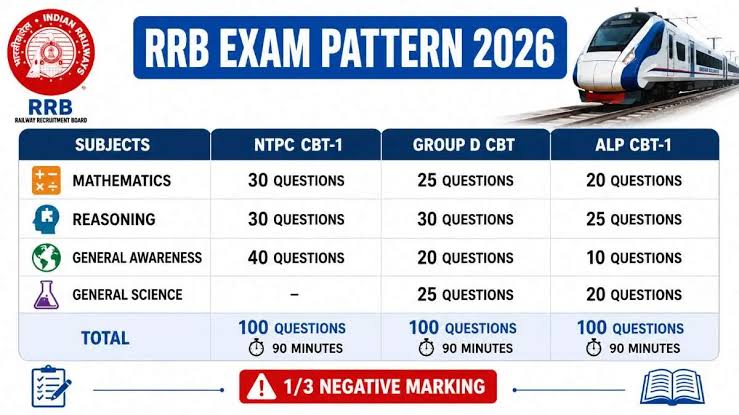
The RRB Teacher CBT is conducted online. The paper includes 100 questions for 100 marks. Each correct answer carries 1 mark. Candidates get 90 minutes to complete the paper. PwBD candidates may get extra time as per rules.
| Subject | Questions | Marks |
| Professional Ability | 50 | 50 |
| General Awareness | 15 | 15 |
| General Intelligence and Reasoning | 15 | 15 |
| Mathematics | 10 | 10 |
| General Science | 10 | 10 |
| Total | 100 | 100 |
There is negative marking of 1/3 mark for each wrong answer. So, candidates should avoid blind guessing and focus on accuracy.
RRB Teacher Selection Process 2026
The selection process may include Computer Based Test, Interview, Skill Test, Document Verification and evaluation for language teachers. The exact stages can vary according to the post.
For teaching posts like PRT, TGT and PGT, professional knowledge and teaching aptitude are very important. For Librarian, Lab Assistant, PTI and Music Tutor posts, professional ability is based on the concerned field. Candidates should read the post-wise details carefully before starting preparation.
Professional Ability Syllabus
Professional Ability carries 50 marks, so it is the most important section of the exam. The syllabus changes according to the post applied for.
For PRT posts, topics include understanding the learner, child development, learning theories, teaching-learning process, classroom environment, inclusive education, school organisation, leadership, curriculum, assessment, lesson planning and NEP-related educational ideas.
For TGT and PGT posts, candidates should prepare education, philosophy of education, sociology of education, educational psychology, curriculum, instruction methods, teaching skills, learner psychology, classroom management and subject-related teaching ability.
RRB Teacher PRT Syllabus
The PRT syllabus focuses on child learning and primary education. Important topics include growth and development, domains of development, needs of children, role of family and school, learner differences, inclusive education and classroom support.
Candidates should also prepare behaviourism, cognitivism, constructivism, lesson planning, teaching-learning materials, assessment methods, foundational literacy and numeracy, early childhood care and education, competency-based learning and child rights. PRT aspirants should focus on practical classroom situations because questions may test real teaching understanding.
RRB Teacher TGT and PGT Syllabus
For TGT and PGT posts, the syllabus is more advanced and includes educational philosophy, Indian and Western thinkers, sociology of education, role of school and society, education as a tool for social change, human values, democracy, discipline and child rights.
Educational psychology is also important. Candidates should prepare intelligence, learning, motivation, growth and development, exceptional children, evaluation methods and classroom behaviour. Curriculum development, instructional methods and teaching competencies should be revised carefully.
Mathematics Syllabus
Mathematics includes basic school-level topics. Important areas are number system, BODMAS, decimals, fractions, LCM, HCF, ratio and proportion, percentage, mensuration, time and work, time and distance, simple interest, compound interest, profit and loss, algebra, geometry and trigonometry.
Candidates should also prepare elementary statistics, square root, age-based problems, calendar, clock and pipes and cisterns. Since only 10 questions are asked, the section can be scoring with regular formula revision and short practice.
General Intelligence and Reasoning Syllabus
Reasoning checks logical thinking and problem-solving ability. Important topics include analogy, alphabet series, number series, coding-decoding, mathematical operations, blood relation, syllogism, Venn diagram, direction sense, classification, similarities and differences, statement and assumption, conclusion, decision-making and data sufficiency.
Reasoning should be practised daily. Candidates should learn shortcut methods but should not skip basic concepts.
General Awareness Syllabus
General Awareness includes current affairs, Indian history, freedom movement, Indian geography, Indian polity, Constitution, Indian economy, culture, sports and environmental issues.
Candidates should also prepare general scientific and technological developments. For better marks, revise national events, education-related updates, government schemes, important days, awards and major appointments.
General Science Syllabus
General Science is generally based on Class 10 level concepts. It includes Physics, Chemistry and Life Sciences.
Physics topics may include motion, force, work, energy, light, sound, electricity and magnetism. Chemistry topics include matter, atoms, molecules, acids, bases, salts, metals, non-metals and everyday chemical reactions. Life Science topics include human body, nutrition, diseases, plants, animals, environment and basic biology.
Syllabus for Other RRB Teacher Posts
For PTI posts, candidates should prepare physical education, anatomy, physiology, fitness, sports injuries, health education, sports medicine, recreation, nutrition and important games.
For Librarian posts, topics include library classification, cataloguing, knowledge organisation, bibliographic description, library science principles and educational psychology.
For Lab Assistant posts, the syllabus may include Physics, Chemistry and Biology topics depending on the laboratory subject. For Music Tutor, candidates should prepare Indian music, ragas, talas, gharanas, notation system, acoustics and music history.
How to Prepare for RRB Teacher 2026
Start by checking the post-wise syllabus. Professional Ability carries half of the total marks, so prepare it first. After that, divide time for reasoning, maths, science and awareness.
Make short notes for teaching theories, educational thinkers, child development, curriculum, classroom management and NEP-related topics. Practise objective questions daily. Take mock tests in the 90-minute format to improve speed and accuracy.
Since negative marking is applicable, learn question selection. Attempt confident questions first and avoid unnecessary risk in doubtful questions.
FAQs on RRB Teacher Syllabus 2026 and Exam Pattern
Q1. What is the exam pattern of RRB Teacher 2026?
The RRB Teacher CBT has 100 objective questions for 100 marks. The exam duration is 90 minutes.
Q2. Is there negative marking in RRB Teacher exam?
Yes, 1/3 mark is deducted for each wrong answer. Candidates should avoid blind guessing.
Q3. Which section carries the highest marks in RRB Teacher exam?
Professional Ability carries the highest weightage with 50 questions for 50 marks.
Q4. How should beginners start RRB Teacher preparation?
Beginners should first study the post-wise professional syllabus, then prepare reasoning, maths, science and awareness with regular mock tests and revision.