For many young candidates in Uttar Pradesh, the UPSSSC Excise Constable exam is a strong opportunity to enter a state government job with discipline, field responsibility and long-term career security. The post of Excise Constable, also called Aabkari Sipahi, is connected with the excise department’s work, enforcement support, field checking, legal compliance and government revenue protection. So, this exam is not only about reading general knowledge; it also needs awareness of Uttar Pradesh, excise-related policies, computer basics and current issues.
Many aspirants start preparation with random GK books or old constable exam material. This can create a big gap because the UPSSSC Excise Constable Syllabus 2026 has a clear structure. The paper includes Indian history, polity, economy, science, environment, data interpretation, computer knowledge and Uttar Pradesh-specific topics. Since there is negative marking, candidates must prepare with accuracy, not guesswork. A proper understanding of the syllabus and exam pattern can help you plan your studies in a smarter and more practical way.
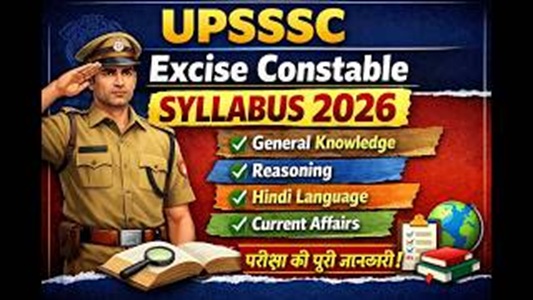
UPSSSC Excise Constable 2026 Overview
| Particular | Details |
| Exam Name | UPSSSC Excise Constable Exam 2026 |
| Conducting Body | Uttar Pradesh Subordinate Services Selection Commission |
| Post Name | Excise Constable / Aabkari Sipahi |
| Exam Mode | Offline / OMR Based as per recruitment process |
| Type of Questions | Objective Multiple Choice Questions |
| Total Questions | 100 |
| Total Marks | 100 |
| Exam Duration | 2 Hours |
| Marking Scheme | 1 mark for each correct answer |
| Negative Marking | 1/4 mark for each wrong answer |
| Main Parts | General Studies, Computer & IT, Uttar Pradesh GK |
| Selection Stages | Written Exam, physical/document stages as applicable |
UPSSSC Excise Constable Exam Pattern 2026
The UPSSSC Excise Constable written exam includes 100 objective-type questions for 100 marks. Candidates get 2 hours to complete the paper. Each correct answer carries 1 mark. For every incorrect answer, 1/4 mark is deducted.
| Part | Subject | Questions | Marks |
| Part 1 | History of India and Indian National Movement | 5 | 5 |
| Part 1 | Geography of India and the World | 5 | 5 |
| Part 1 | Economic and Social Development of India | 10 | 10 |
| Part 1 | Indian Polity and Indian Constitution | 10 | 10 |
| Part 1 | General Science and Technology | 5 | 5 |
| Part 1 | Environmental Ecology and Disaster Management | 5 | 5 |
| Part 1 | Current Events of National and International Importance | 5 | 5 |
| Part 1 | Data Interpretation | 10 | 10 |
| Part 1 | Important Legal Provisions and Policies Related to Excise in UP | 10 | 10 |
| Part 2 | Computer and Information Technology | 15 | 15 |
| Part 3 | General Knowledge of Uttar Pradesh | 20 | 20 |
| Total | 100 | 100 |
The biggest scoring areas are Uttar Pradesh GK, Computer and IT, Excise-related provisions, Polity, Economy and Data Interpretation. Candidates should give extra attention to these sections because they carry higher weightage.
History of India and Indian National Movement
This section includes basic Indian history and freedom movement topics. Candidates should prepare ancient, medieval and modern history in a short and exam-focused way. Important areas include social, cultural, economic and political aspects of Indian history.
For the Indian National Movement, focus on the revolt of 1857, rise of nationalism, Congress sessions, important movements, revolutionary activities, Gandhian movements and independence-related events. Since only 5 questions are asked, revision should be crisp and factual.
Indian Polity and Constitution Syllabus
Polity is an important part of the paper because it carries 10 marks. Important topics include constitutional development, features of the Indian Constitution, fundamental rights, fundamental duties, directive principles, President, Prime Minister, Parliament, Governor, Chief Minister, State Legislature, judiciary, election system and governance.
Candidates should also prepare Panchayati Raj, local self-government, public policy, official issues and community development. These topics are useful because the exam is connected with state-level administrative work.
Geography of India and the World
Geography includes both India and world geography. Important Indian geography topics are physical features, rivers, climate, soil, agriculture, horticulture, forestry, animal husbandry, population, urbanisation, transport and natural resources.
World geography should be prepared at a basic level. Focus on continents, oceans, important countries, mountains, rivers, deserts and major global locations. Map-based learning can help candidates remember facts faster.
Indian Economy and Social Development
This section carries 10 marks and needs conceptual clarity. Important topics include economic planning in India, NITI Aayog, Sustainable Development Goals, government budget, financial system, agriculture, industry, trade, land reforms, liberalisation, globalisation and infrastructure development.
Candidates should also understand poverty, unemployment, social development, rural development and government welfare schemes. Since excise work is linked with state revenue, basic understanding of economy and government finance can be helpful.
Science, Technology, Environment and Disaster Management
General Science and Technology includes India’s achievements in science, space technology, defence technology, energy sources, biotechnology, nanotechnology, microbiology, intellectual property rights and digital rights.
Environment and disaster management include climate change, environmental impact, pollution, biodiversity, Disaster Management Act, NDMA, SDMA, NDRF, SDRF and global disaster mitigation efforts. Candidates should prepare these topics with current examples.
Current Affairs and Data Interpretation
Current affairs include recent national and international events. Candidates should focus on government schemes, awards, sports, defence exercises, appointments, science updates, economic news and Uttar Pradesh-related current events.
Data Interpretation includes graphs, tables, charts, diagrams and statistical information. Candidates should practise basic calculation, percentage, ratio, average and simple analysis. This section can be scoring if practised regularly.
Excise-Related Legal Provisions and Policies
This is a very important section because it is directly connected with the post. Candidates should prepare basic legal provisions and policies related to excise in Uttar Pradesh. Focus on excise rules, liquor regulation, enforcement basics, illegal trade control, licensing awareness, revenue protection and public safety-related policies.
You do not need to study law like a lawyer, but you should understand the basic purpose and working of excise rules in the state.
Computer and Information Technology Syllabus
Computer and IT carries 15 marks, so it should not be ignored. Important topics include computer history, basics of IT, internet, World Wide Web, hardware, software, input-output devices, IP address, email, printers, tablets, mobile devices, MS Word, MS Excel, operating system, social networking and e-governance.
Candidates should also prepare digital financial tools, cyber security, artificial intelligence, big data, machine learning, deep learning, Internet of Things and India’s achievements in IT.
General Knowledge of Uttar Pradesh
UP GK carries 20 marks, making it one of the most important sections. Candidates should prepare Uttar Pradesh history, culture, art, architecture, festivals, folk dances, literature, regional languages, heritage, geography, climate, soil, forests, wildlife, minerals, economy, agriculture, industry, employment, polity and administration.
Also revise important tourist places, current events, state government schemes, major cities, rivers, national parks, famous personalities and recent achievements of Uttar Pradesh.
How to Prepare for UPSSSC Excise Constable 2026
Start by dividing the syllabus into three parts: General Studies, Computer and IT, and Uttar Pradesh GK. Give daily time to UP GK and current affairs because they need repeated revision. For polity, economy and history, make short notes instead of reading very large books.
Practise Data Interpretation regularly because it can improve your score with less theory. For Computer and IT, revise definitions, shortcuts, digital tools and cyber safety topics. Since negative marking is 1/4, attempt questions carefully and avoid blind guessing.
Mock tests are very important. Try to complete 100 questions within 2 hours during practice. After every test, check where you lost marks and revise weak topics before the next mock.
FAQs on UPSSSC Excise Constable Syllabus 2026 and Exam Pattern
Q1. How many questions are asked in UPSSSC Excise Constable 2026?
The exam has 100 objective-type questions for 100 marks. The total duration is 2 hours.
Q2. Is there negative marking in UPSSSC Excise Constable exam?
Yes, there is negative marking. For every wrong answer, 1/4 mark is deducted, so candidates should avoid random guessing.
Q3. Which section is most important in UPSSSC Excise Constable syllabus?
Uttar Pradesh GK, Computer and IT, Excise-related legal provisions, Polity, Economy and Data Interpretation are important because they carry strong weightage in the paper.
Q4. Can I prepare for UPSSSC Excise Constable without coaching?
Yes, self-study is possible if you follow the syllabus, make short notes, revise UP GK and current affairs regularly, practise computer questions and attempt mock tests with proper time management.