Haryana’s fields don’t run on policy alone — someone has to translate crop science, soil health, and irrigation planning into guidance farmers can actually use, and that’s the daily reality of an Agriculture Development Officer. For agriculture graduates in the state, HPSC ADO is about as close to hands-on impact as a government post gets.
The recurring failure here: candidates bury themselves in agriculture subjects and let Haryana GK, reasoning, and current affairs slide, only to clear the screening test and then struggle in the subject knowledge round because core agriculture topics weren’t revised deeply enough. Start with the HPSC ADO Syllabus 2026 and Exam Pattern — knowing the stages, marks, and subject weightage upfront turns a scattered study routine into one that actually matches what the exam demands.
HPSC ADO 2026 Overview
| Particular | Details |
| Exam Name | HPSC ADO Exam 2026 |
| Conducting Body | Haryana Public Service Commission |
| Post Name | Agriculture Development Officer |
| Department | Agriculture and Farmers Welfare Department, Haryana |
| Selection Stages | Screening Test, Subject Knowledge Test and Interview |
| Screening Test Type | Objective Multiple Choice Questions |
| Screening Test Marks | 100 Marks |
| Screening Test Duration | 2 Hours |
| Subject Knowledge Test Marks | 150 Marks |
| Subject Knowledge Test Duration | 3 Hours |
| Negative Marking | 0.25 mark for each wrong answer in Screening Test |
| Main Subjects | General Awareness, Haryana GK, Reasoning, Agriculture |
| Final Focus | Subject Knowledge Test and Interview |
HPSC ADO Selection Process 2026
The HPSC ADO selection process generally includes three stages. The first stage is the Screening Test. This test is mainly used to shortlist candidates for the next round.
The second stage is the Subject Knowledge Test. This stage is very important because it checks the candidate’s deep understanding of agriculture. The third stage is the Interview, where personality, subject clarity, field awareness and suitability for the ADO role are assessed.
Candidates should not prepare only for the first stage. The final selection depends heavily on subject knowledge and interview performance, so agriculture concepts must be prepared from the beginning.
HPSC ADO Screening Test Pattern 2026
The Screening Test consists of objective-type questions. It is conducted for 100 marks, and candidates get 2 hours to complete the paper.
| Subject Area | Questions/Marks |
| General Science | Included in 100 Marks |
| Current Affairs | Included in 100 Marks |
| History of India | Included in 100 Marks |
| Indian and World Geography | Included in 100 Marks |
| Indian Culture, Polity and Economy | Included in 100 Marks |
| General Mental Ability and Reasoning | Included in 100 Marks |
| Basic Numeracy and Data Interpretation | Included in 100 Marks |
| Haryana General Knowledge | Included in 100 Marks |
| Total | 100 Marks |
Each question carries equal marks. There is negative marking of 0.25 mark for wrong answers. Candidates should avoid random guessing and attempt questions carefully.
HPSC ADO Subject Knowledge Test Pattern
The Subject Knowledge Test is conducted for 150 marks and has a duration of 3 hours. This test is based on agriculture-related topics and checks conceptual understanding, practical application and subject depth.
Candidates have to score the required qualifying marks to move towards the Interview stage. Since this paper carries strong weightage in the selection process, it should be treated as the main part of preparation.
HPSC ADO Screening Test Syllabus 2026
The Screening Test syllabus includes both general studies and Haryana-specific topics. Important areas include General Science, current events of national and international importance, History of India, Indian and World Geography, Indian Culture, Indian Polity, Indian Economy and General Mental Ability.
Basic Numeracy includes numbers, relationships between numbers, order of magnitude, data interpretation, charts, graphs, tables and data sufficiency at Class 10 level. Haryana GK includes history, geography, polity, economy, culture, agriculture, important personalities, schemes and current developments of the state.
This section can be scoring if candidates revise regularly. Short notes on Haryana GK and current affairs are very useful.
HPSC ADO Agriculture Syllabus 2026
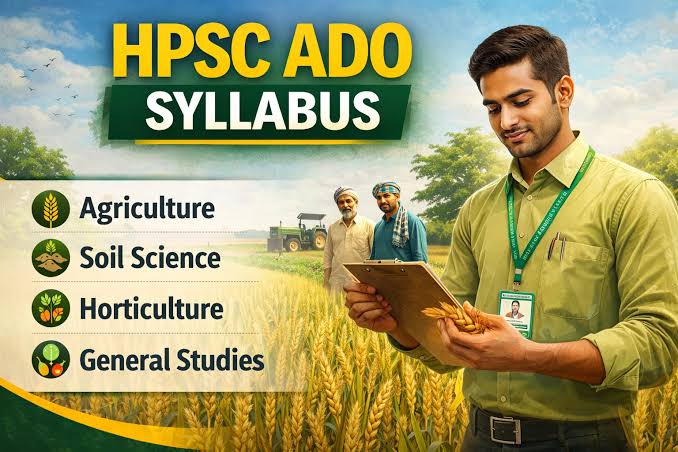
The agriculture syllabus is wide and should be prepared topic by topic. Important areas include ecology and environment, cropping systems, farming systems, forestry, weed management, soil science, water management, agricultural economics, extension education, genetics, plant breeding, seed technology, plant physiology, horticulture, plant protection and food security.
Candidates should understand practical agriculture instead of memorising only definitions. Questions may be connected with crop production, irrigation, pest control, soil fertility, climate change, seed quality and government programmes related to farmers.
Ecology, Cropping System and Farming
This part includes human and ecological relationships, natural resource conservation, environmental factors affecting crops and livestock, agro-ecology, environmental pollution, climate change, greenhouse effect and use of remote sensing and GIS in agriculture.
Cropping system topics include cropping patterns in different agro-climatic zones, organic farming, precision farming, sustainable agriculture and production practices of cereals, pulses, oilseeds, fibre crops, sugar crops and fodder crops.
Soil Science and Water Management
Soil Science is one of the most important parts of the HPSC ADO syllabus. Candidates should prepare soil formation, Indian soil types, physical and chemical properties of soil, soil fertility, soil testing, integrated nutrient management, biofertilizers and soil reclamation.
Water Management includes irrigation scheduling, water-use efficiency, rainwater harvesting, drip irrigation, sprinkler irrigation, drainage of waterlogged soils and irrigation water quality. For Haryana candidates, this section is very practical because water management is a major agricultural issue in the state.
Plant Breeding, Seed Technology and Plant Physiology
Genetics and Plant Breeding include cell structure, inheritance, mutation, polyploidy, breeding methods, hybrid vigour, GM crops and biotechnology in crop improvement.
Seed Technology includes seed production, processing, certification, storage, DNA fingerprinting, seed registration and role of public and private sectors. Plant Physiology includes photosynthesis, respiration, nutrient uptake, plant hormones, seed dormancy and stress physiology.
Horticulture and Plant Protection
Horticulture includes fruits, vegetables, spices, flowers, plantation crops, protected cultivation, post-harvest technology, landscaping and medicinal plants. Candidates should also understand the role of horticulture in nutrition and income generation.
Plant Protection includes identification of pests and diseases, integrated pest management, biological control, storage pest management, plant quarantine and safe pesticide use. This section should be prepared with examples of important crops.
How to Prepare for HPSC ADO 2026
Start with the agriculture syllabus because it is the backbone of the exam. Divide the syllabus into weekly targets such as soil science, agronomy, plant breeding, horticulture and plant protection.
For the Screening Test, prepare Haryana GK, current affairs, reasoning and basic numeracy daily. Practise MCQs with a timer because speed is important. For the Subject Knowledge Test, make short notes and revise agriculture concepts repeatedly.
Smart Tips for HPSC ADO Aspirants
Do not ignore Haryana-specific agriculture issues. Study cropping patterns, irrigation challenges, soil problems, farmer schemes and rural development programmes of the state.
Maintain separate notebooks for agriculture facts, Haryana GK, current affairs and formulas. Practise previous year-style questions and revise frequently. During the Screening Test, avoid blind guessing because negative marking can reduce your score.
FAQs on HPSC ADO Syllabus 2026 and Exam Pattern
Q1. What is the selection process for HPSC ADO 2026?
The HPSC ADO selection process includes Screening Test, Subject Knowledge Test and Interview.
Q2. What is the exam pattern of HPSC ADO Screening Test?
The Screening Test is objective type and carries 100 marks. The duration is 2 hours, and negative marking is applicable.
Q3. Which subject is most important for HPSC ADO?
Agriculture is the most important subject because the Subject Knowledge Test checks deep understanding of agriculture-related topics.
Q4. How should beginners start HPSC ADO preparation?
Beginners should first understand the syllabus, then prepare agriculture subjects along with Haryana GK, current affairs, reasoning and basic numeracy. Regular revision and mock tests are very helpful.