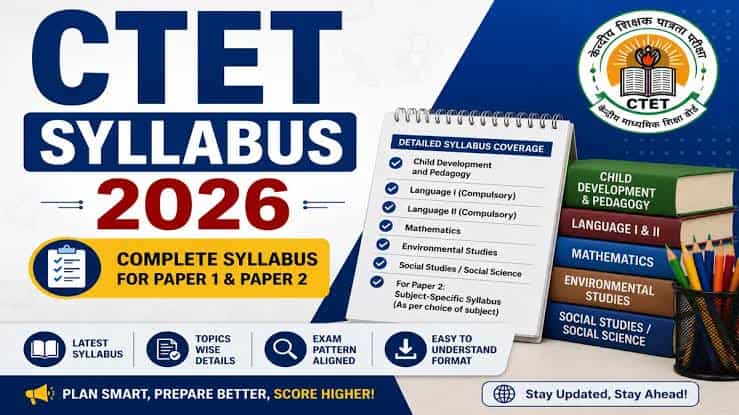
For many teaching aspirants in India, CTET Paper 2 is a major step toward becoming an upper-primary teacher for Classes 6 to 8. This is the stage where students move from basic learning to subject-based understanding. A teacher handling these classes needs more than textbook knowledge. They must understand child behaviour, language development, subject concepts, classroom diversity and practical teaching methods.
CTET Paper 2 matters because it helps candidates become eligible for teaching opportunities in central schools and many other institutions where CTET qualification is accepted. But preparation should not be random. Many candidates prepare only Child Development and Pedagogy but ignore Language II. Some focus on Maths and Science but do not practise teaching-based questions. Others choose Social Science but fail to revise maps, history timelines and civics concepts properly. A clear understanding of the CTET Paper 2 Syllabus 2026 and Exam Pattern helps candidates prepare in a focused and scoring manner.
CTET Paper 2 2026 Overview
| Particular | Details |
| Exam Name | CTET Paper 2 Exam 2026 |
| Full Form | Central Teacher Eligibility Test Paper 2 |
| Conducting Body | Central Board of Secondary Education |
| Teaching Level | Classes 6 to 8 |
| Exam Mode | Offline OMR-Based Exam |
| Question Type | Objective Multiple Choice Questions |
| Total Questions | 150 |
| Total Marks | 150 |
| Exam Duration | 2 Hours 30 Minutes |
| Negative Marking | No Negative Marking |
| Main Sections | Child Development, Language I, Language II, Maths & Science or Social Science |
| Certificate Validity | Lifetime |
| Purpose | Eligibility for Upper Primary Teacher Posts |
CTET Paper 2 Exam Pattern 2026
CTET Paper 2 includes 150 multiple-choice questions for 150 marks. Each question carries 1 mark. There is no negative marking, so candidates should attempt all questions carefully.
| Section | Questions | Marks |
| Child Development and Pedagogy | 30 | 30 |
| Language I | 30 | 30 |
| Language II | 30 | 30 |
| Mathematics and Science | 60 | 60 |
| Social Studies/Social Science | 60 | 60 |
| Total | 150 | 150 |
Candidates have to choose either Mathematics and Science or Social Studies/Social Science based on their teaching subject preference. Candidates who want to teach Maths or Science should select Mathematics and Science. Candidates who want to teach Social Science should select Social Studies/Social Science.
CTET Paper 2 Selection and Eligibility Purpose
CTET is an eligibility test, not a direct recruitment exam. After qualifying CTET Paper 2, candidates become eligible to apply for teaching posts for Classes 6 to 8 in schools where CTET qualification is required.
Qualifying CTET does not guarantee a job by itself. Candidates still need to apply for vacancies released by schools, government bodies or recruitment boards. However, CTET qualification is a very important requirement for many teaching opportunities.
Child Development and Pedagogy Syllabus
Child Development and Pedagogy is one of the most important sections because it checks whether a candidate understands children, learning behaviour and classroom situations.
Important topics include child development from 11 to 14 years, principles of development, influence of heredity and environment, socialisation, gender as a social construct, individual differences, inclusive education, learning difficulties, gifted learners and children with special needs.
Pedagogy topics include learning and teaching, how children think and learn, motivation, classroom interaction, assessment, continuous and comprehensive evaluation, constructivism, child-centred learning and activity-based teaching.
Candidates should focus on concept-based understanding. Many questions are situation-based, so memorising theory alone is not enough.
Language I Syllabus
Language I checks the candidate’s proficiency in the language selected as the first language. It generally focuses on comprehension, grammar and teaching methods.
Important topics include reading comprehension, unseen passages, grammar usage, vocabulary, language functions, sentence formation and verbal ability. Pedagogy of language development includes principles of language teaching, role of listening and speaking, language skills, learning materials, remedial teaching and assessment of language learning.
Candidates should practise passages regularly. Language I can be scoring if grammar and comprehension are handled carefully.
Language II Syllabus
Language II is different from Language I and checks basic understanding of a second language. The level is usually practical and teaching-oriented.
Important topics include comprehension passages, grammar, vocabulary, sentence correction, language usage and verbal communication. Pedagogy topics include language acquisition, challenges of teaching language in a diverse classroom, learning materials, multilingual classroom approach and evaluation of language skills.
Candidates should not ignore Language II. Even candidates who are strong in their subject can lose marks if they do not practise language-based questions.
Mathematics Syllabus for CTET Paper 2
Mathematics is meant for candidates who want to teach Maths and Science. Important topics include number system, knowing our numbers, whole numbers, negative numbers, integers, fractions, decimals, algebra, ratio and proportion, basic geometrical ideas, understanding elementary shapes, symmetry, construction, mensuration and data handling.
Pedagogical issues include nature of Mathematics, logical thinking, place of Mathematics in curriculum, language of Mathematics, community Mathematics, evaluation, remedial teaching and problems of teaching Maths.
Candidates should prepare both calculation and teaching approach. CTET does not only ask “what is the answer”; it may also ask how a concept should be taught to children.
Science Syllabus for CTET Paper 2
Science includes topics from everyday life and school-level science. Important topics include food, materials, the world of living, moving things, people and ideas, how things work, natural phenomena and natural resources.
Candidates should prepare topics like plants, animals, human body, health, nutrition, force, motion, electricity, magnetism, light, sound, water, air, soil, environment and conservation.
Pedagogical issues include nature and structure of Science, observation, experimentation, innovation, scientific attitude, teaching aids, evaluation and remedial teaching. Practical examples are very useful while preparing Science pedagogy.
Social Studies/Social Science Syllabus
Candidates choosing Social Studies/Social Science should prepare History, Geography, Social and Political Life, and pedagogical issues.
History topics include ancient, medieval and modern Indian history, early societies, empires, culture, architecture, social change, colonialism and freedom movement.
Geography topics include Earth, globe, maps, environment, natural resources, agriculture, human environment, air, water, minerals, transport and communication.
Social and Political Life includes democracy, Constitution, government, diversity, gender, social justice, local government, parliament, judiciary and rights.
Pedagogy includes teaching Social Science, classroom discussion, map work, project work, sources, timelines, field visits, assessment and critical thinking.
How to Prepare for CTET Paper 2 2026
Start by choosing your fourth section carefully: Mathematics and Science or Social Studies/Social Science. After that, divide your preparation into four parts: Child Development, Language I, Language II and subject-specific section.
For Child Development, focus on concepts and classroom-based questions. For languages, practise passages and grammar daily. For Maths and Science, revise NCERT-level concepts and pedagogy. For Social Science, prepare maps, timelines, civics concepts and teaching methods.
Attempt mock tests in the 150-question format. Since there is no negative marking, practise attempting the full paper within 2 hours 30 minutes.
Smart Tips for CTET Paper 2 Aspirants
Do not prepare CTET like a normal subject exam. It is a teacher eligibility test, so pedagogy is very important in every section.
Read NCERT books for Classes 6 to 8, especially for Maths, Science and Social Science. Make short notes for child development theories, grammar rules, teaching methods and important subject topics. Revise regularly and practise previous-year-style questions to understand the actual exam approach.
FAQs on CTET Paper 2 Syllabus 2026 and Exam Pattern
Q1. What is the exam pattern of CTET Paper 2 2026?
CTET Paper 2 has 150 multiple-choice questions for 150 marks. The exam duration is 2 hours 30 minutes.
Q2. Is there negative marking in CTET Paper 2?
No, there is no negative marking in CTET Paper 2. Candidates should try to attempt all questions carefully.
Q3. Who should appear for CTET Paper 2?
Candidates who want to become teachers for Classes 6 to 8 should appear for CTET Paper 2.
Q4. Which section should I choose in CTET Paper 2: Maths & Science or Social Science?
Choose Mathematics and Science if you want to teach Maths or Science. Choose Social Studies/Social Science if your teaching subject is History, Geography, Civics or Social Science.