For lakhs of teaching aspirants in Rajasthan, REET is not just an exam date on the calendar. It is a real chance to enter the government school system, get teaching eligibility, and move closer to a stable career. Many students start preparing with full energy, but after a few weeks they get stuck because they do not clearly understand what to study for Level 1, what to study for Level 2, how many questions come from each subject, and how the marking pattern works.
This is where the REET Syllabus 2026 and Exam Pattern becomes very important. A candidate who understands the paper structure from the beginning can prepare in a much smarter way. Instead of reading everything randomly, you can divide the syllabus subject-wise, focus on scoring areas, practise the right type of questions, and avoid mistakes in the OMR sheet. REET is not only about knowledge; it also checks teaching understanding, child psychology, language skills, and classroom-based concepts.
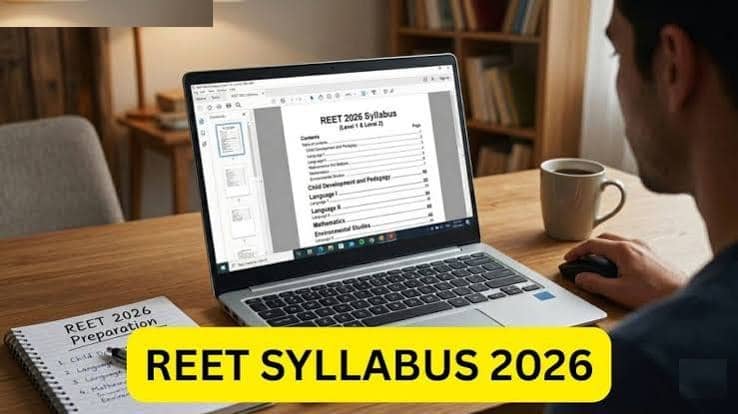
REET 2026 Quick Overview
| Particular | Details |
| Exam Name | Rajasthan Eligibility Examination for Teachers |
| Popular Name | REET |
| Levels | Level 1 and Level 2 |
| Level 1 For | Classes 1 to 5 |
| Level 2 For | Classes 6 to 8 |
| Question Type | Objective MCQs |
| Total Questions | 150 |
| Total Marks | 150 |
| Exam Duration | 2 hours 30 minutes |
| Mode | Offline/OMR based |
| Main Subjects | Child Development, Languages, Mathematics, EVS, Science/Social Studies |
REET Exam Pattern 2026
REET 2026 is expected to follow a two-level structure. Candidates who want to teach primary classes from 1 to 5 appear for Level 1. Candidates who want to teach upper primary classes from 6 to 8 appear for Level 2. Those who are eligible for both levels can apply for both papers.
Each paper has 150 questions for 150 marks. Every question carries 1 mark. The duration of the exam is 2 hours and 30 minutes. The paper is objective type, so candidates have to select the correct option on the OMR sheet.
A major point candidates should remember is the use of the fifth option in the OMR pattern. If a candidate does not want to attempt a question, the fifth option should be marked instead of leaving the question blank. Leaving questions blank may lead to a deduction as per the latest OMR rules. So, during preparation, candidates should practise full-length papers with proper OMR discipline.
REET Level 1 Exam Pattern 2026
REET Level 1 is for candidates who want to become teachers for Classes 1 to 5. The paper focuses on child psychology, basic teaching methods, language understanding, mathematics, and environmental studies.
| Subject | Questions | Marks |
| Child Development and Pedagogy | 30 | 30 |
| Language I | 30 | 30 |
| Language II | 30 | 30 |
| Mathematics | 30 | 30 |
| Environmental Studies | 30 | 30 |
| Total | 150 | 150 |
In Level 1, the questions are designed around primary school teaching. Candidates should not think that the paper is only about school-level facts. Many questions are based on how children learn, how teachers should handle classroom situations, and how concepts should be explained to young learners.
REET Level 2 Exam Pattern 2026
REET Level 2 is for candidates aiming to teach Classes 6 to 8. This paper includes child development, two languages, and one subject-specific section.
| Subject | Questions | Marks |
| Child Development and Pedagogy | 30 | 30 |
| Language I | 30 | 30 |
| Language II | 30 | 30 |
| Mathematics and Science / Social Studies | 60 | 60 |
| Total | 150 | 150 |
Candidates from Mathematics and Science backgrounds usually choose the Maths and Science section. Candidates from humanities or social science backgrounds generally choose Social Studies. The subject section carries 60 marks, so it plays a very important role in the final score.
REET Child Development and Pedagogy Syllabus 2026
Child Development and Pedagogy is common in both Level 1 and Level 2. This section tests whether the candidate understands children, learning behaviour, classroom challenges, and teaching methods.
Important topics include child growth and development, role of heredity and environment, individual differences, personality, intelligence, learning theories, motivation, inclusive education, learning difficulties, classroom interaction, assessment, evaluation, action research, and Right to Education.
This section should be prepared with practical understanding. For example, questions may ask how a teacher should help a slow learner, how to encourage activity-based learning, or how to handle diversity in the classroom.
REET Language I and Language II Syllabus 2026
REET includes two language papers. Language I is usually related to the medium of instruction chosen by the candidate, while Language II is another selected language. Options generally include Hindi, English, Sanskrit, Urdu, Sindhi, Punjabi, and Gujarati.
The language syllabus includes comprehension, grammar, vocabulary, language teaching methods, principles of language learning, development of language skills, unseen passages, sentence formation, and classroom-based language learning.
Candidates should not prepare language sections only by memorising grammar rules. Reading comprehension, teaching methods, and usage-based questions are equally important. Daily reading and previous year question practice can improve accuracy in this section.
REET Mathematics Syllabus 2026
For Level 1, Mathematics includes basic topics such as numbers, addition, subtraction, multiplication, division, fractions, measurement, time, money, shapes, patterns, data handling, and basic geometry. The focus is on primary-level mathematical understanding and teaching methods.
For Level 2, Mathematics becomes more advanced. Important topics include integers, fractions, algebraic expressions, equations, ratio and proportion, percentage, profit and loss, simple interest, lines and angles, triangles, mensuration, area, volume, statistics, graph, and practical geometry.
Pedagogy of Mathematics is also important. Candidates should understand how to teach maths through examples, activities, problem-solving, and real-life situations.
REET Environmental Studies Syllabus 2026
Environmental Studies is part of Level 1. It includes family, food, water, shelter, transport, plants, animals, festivals, local environment, natural resources, health, hygiene, community life, and environmental protection.
The EVS section often looks simple, but questions can be tricky because they connect daily life with teaching methods. Candidates should focus on Rajasthan-related examples, local surroundings, classroom activities, observation-based learning, and child-friendly teaching methods.
REET Science Syllabus 2026
Science is included in the Level 2 Mathematics and Science section. Important topics include living organisms, human body, health, microorganisms, force and motion, heat, light, sound, electricity, chemical substances, natural resources, solar system, reproduction, adolescence, and environment.
Science preparation should be concept-based. Instead of only memorising facts, candidates should understand experiments, examples, diagrams, and classroom applications.
REET Social Studies Syllabus 2026
Social Studies is an important option for Level 2 candidates. It includes history, geography, civics, Indian culture, Rajasthan history and geography, Indian Constitution, democracy, resources, agriculture, industries, social reform movements, medieval and modern India, and pedagogical issues.
Candidates should give special attention to Rajasthan-related topics because they are highly relevant for the exam. Map-based understanding, timelines, important personalities, and constitutional concepts should be revised regularly.
How to Prepare for REET 2026
Start your preparation by selecting the correct level. Then divide the syllabus into weekly targets. Do not study all subjects in a scattered way. Keep Child Development, Language, and your main subject in regular rotation.
Practise previous year papers because they show the real exam level. Make short notes for pedagogy, grammar rules, formulas, Rajasthan GK points, and teaching methods. Attempt mock tests in 150-minute time limits so that you learn speed management.
Most importantly, practise marking answers properly. Since the OMR pattern is strict, candidates should develop the habit of not leaving questions blank. In the final exam, even small carelessness can affect the score.
FAQs on REET Syllabus 2026 and Exam Pattern
Q1. Is REET Level 1 and Level 2 syllabus the same?
No, both are different. Level 1 is for Classes 1 to 5 and includes Mathematics and Environmental Studies. Level 2 is for Classes 6 to 8 and includes either Mathematics and Science or Social Studies as the main subject section.
Q2. How many questions are asked in REET 2026?
REET paper has 150 objective-type questions for 150 marks. The exam duration is 2 hours and 30 minutes for each level.
Q3. Is Child Development and Pedagogy important for REET?
Yes, it is very important because it carries 30 marks in both Level 1 and Level 2. It also helps candidates understand classroom teaching, learning behaviour, child psychology, and inclusive education.
Q4. What is the best way to complete the REET syllabus?
The best way is to divide the syllabus subject-wise, revise regularly, solve previous year questions, and attempt mock tests. Candidates should focus equally on content knowledge and pedagogy because REET checks teaching ability, not only theory knowledge.